Added: Scale node in Compositor.

- Only works for RGBA buffers now
- I have added an option "Relative" or "Absolute" scale. So you can also
  define actual pixels for scale. Values for scale are reset when you
  switch, to prevent too weird situations.
- Scaling wasn't foreseen to work with the preview-panel in UV window, this
  preview cropping only happens for Image and RenderResult nodes... actually
  should be done for the scale too. I wait with t hat though... this preview
  method isn't very advanced yet.
- The pass_on_compbuf() here crashed in tests with preview panel, that's
  weak code... I have to recode that. For time being I use the
  dupalloc_compbuf to have it stable.
exception of the clone tool.

One level undo for image- and texturepaint, only storing those tiles
that changed.

Test to improve texturepaint performance using glTexSubImage2D, only
enabled with 2^n sized textures and mipmapping off. Painting a 2048x2048
texture is then pretty smooth here, as long as the geometry is not too
complex.
- this patch adds verse support for SCons, which can be enabled by
    giving WITH_BF_VERSE=1, ie. on command-line
  - this patch also adds a custom lib dir possibility. From the patch description:


 "To set a custom ../lib dir, put LCGDIR="path to lib dir, including the platform folder name!" in your user-config.py."

* Fixed win32-vc-config.py so that it links to the proper library. Reported by Brandano.
- ImagePaint now uses ImBuf directly, and the rect blending functions
  were moved into the imbuf module.
- The brush spacing, timing and sampling was abstracted into brush.c, for
  later reuse in other paint modes.

Float ImagePaint support.

Textured Brushes:
- Only the first texture channel is used now.
- Options for size and offset should be added, but need to find some space
  in the panel, or add a second one ..
Rewrote the video seek code again. This time it is a _lot_ simpler and a lot
better.

For those interested: instead of letting ffmpeg choose the right final
position, we let it preseek (maybe to I-frame in the rare case, that is
implemented) and then scan for the correct frame on DTS basis by hand.

We therefor only have to seek once and remove all those frame-jumping
jerkiness, people noticed in the same step.

Tested with msmpeg, hd-mpeg2 and DV.
- patch from Douglas with endian fixes
- Makefile adds static libiconv.a from lib/
- this version will use OpenEXR libs from lib/ too, and is latest release
  with threading support
- openAL is missing, added it as default to not include it
Fixed the blur-plugin (and maybe a lot more) crashes by expecting
future float-buffer aware sequencer-plugins to have a bumped PLUGIN_VERSION
number. Since quality and speed is degraded by converting the float
buffer first to byte, performing the effect on bytes and then converting
back again an additional warning is displayed in the effect strip,
suggesting to update the used sequencer-plugins.

Fixed some more crashes along the way.

Float buffer aware sequencer plugins should
- first check, if the output-ibuf has a rect_float
  => perform all operations with floats (input and output)
- if not: perform everything on bytes (intput and output)
newline missing at end of file fixes:
TypedConstraint.h WheelInfo.h RaycastVehicle.h VehicleRaycaster.h
CcdPhysicsEnvironment.cpp

radiance_hdr.c fixed the following warning by changing type of local variable:
radiance_hdr.c:357: warning: pointer targets in passing argument 3 of
‘fwritecol rs’ differ in signedness

edgeRender.c,edgeRender.h same thing changed type of local vars to get rid
of warnings about signedness

RAS_OpenGLRasterizer.cpp removed unused variable unit line 1295

Kent
New option "Save Buffers", in first Output panel of renderbuttons, will not
allocate all render buffers, but instead save the rendered tiles to exr.
For each scene rendered, a single exr file then is created.
After rendering, the files get read, and only then the memory allocation is
done.

The exr files are saved in the temp dir (from user settings), and have
names derived from the filename+scene name. That way these buffers remain
relatively unique, and can be re-used later too.

Saving all render-layers and passes in a single file (as F3 command) will
be done later. Also reading back the current muli-layer exr files is not
supported yet (will read black). The purpose is that these files then can
be used as input for the Compositor.

One fun thing I added; after rendering once with this option, close
Blender, and restart it. If you have a Composite set up press 'R' on an
active RenderResult node. This will refresh the node(s) and load the exr,
so you can composite again without a re-render.
standard for film scanning, 10 bits/channel and logarithmic. DPX is
derived from Cineon as the ANSI/SMPTE industry standard.
DPX supports 16 bits color/channel, linear as well as logarithmic.

Code has been gratefully copied from CinePaint and was integrated in
Blender by Joe Eagar.

According to CinePaint's dev Robin Rowe the DPX code defaults to log
colorspace. Can't find in the code clues yet how to enable/disable that.
However, tests with write/read of DPX seems to show no visible loss by
log conversion code. Might be because it uses the entire 16 bit range...

CinePaint dpx files have been succesfully imported in a Quantel IQ HD/2K
finishing/grading set without problem, so for now I guess we can
use it! :)

Changes in code: added tests for image magic numbers before entering
the actual reading code. Prevents error prints, and makes it faster too.
(Note; this because Blender doesn't check for extensions, but calls
reading functions on every file until one accepts it. :)
- blur works again (this was a serious bug in gamwarp...)
- seperates all sequence effects into a seperate file with a clean interface
- thereby fixing some obscure segfaults
- seperates the scope views into a seperate file
- adds float support to all effects and scope views
- removes a bad level call to open_plugin_seq
- FFMPEG seeking improved a lot.
- FFMPEG compiles with debian sarge version cleanly
- Makes hdaudio seek and resample code really work
in doing this in the first place.  (1 conditional vs 1 per loop duh)
Thanks for calling me on this Alexander.

(I didn't actually benchmark it to see but its pretty obvious which is less
work for the computer.)

Kent
Basically the check for a type of jpeg was messed up.
I added a imb_is_a_jpeg function since I was working on that bit and
it makes it a little more similar to the other filetypes.

I also changed a switch statement that had the same loop for all
cases, just moved the loop outside of the switch statement.

Kent
passes in single file. Code is currently disabled, commit is mainly to
have a nicer method of excluding OpenEXR dependency from render module.
This should compile with disabled WITH_OPENEXR too.

Reason why EXR is great to include by default in Blender is its feature
to store unlimited layers and channels, and write this tile based. I
need the feature for saving memory; while rendering tiles, all full-size
buffers for all layers and passes are kept in memory now, which can go
into 100s of MB easily.
The code I commit now doesn't allocate these buffers while rendering, but
saves the tiles to disk. In the end is it read back. Overhead for large
renders (like 300 meg buffers) is 10-15 seconds, not bad.

Two more interesting aspects:
- Blender can save such multi-layer files in the temp directory, storing
it with .blend file name and scene name. That way, on each restart of Blender,
or on switching scenes, these buffers can be read. So you always see what was
rendered last. Also great for compositing work.
- This can also become an output image type for rendering. There's plenty of
cases where you want specific layers or passes saved to disk for later use.

Anyhoo, finishing it is another days of work, and I got more urgent stuff
now!
This now is a post-process option only (used to be in render).
  It is only handled within the Imbuf/ module, on conversions from float
  to byte rect, which atm mostly happens on saving images.

- Small fix: when using Scene RenderLayer nodes, the speed vectors for
  these nodes were not created when that scene had "Do Composite" off.
(NOTE: new include dependency in Render module, might need MSVC update!
It has to include the imbuf/intern/openexr/ directory in search path)

-> New Composite node: "Hue Saturation".
Works like the former 'post process' menu. There's no gamma, brightness or
multiply needed in this node, for that the Curves Node functions better.

-> Enabled Toolbox in Node editor
This now also replaces the SHIFT+A for adding nodes. The nodes are
automatically added to the menus, using the 'class' category from the
type definition.

Current classes are (compositor examples):

Inputs: RenderResult, Image
Outputs: Composite, Viewer
Color Ops: RGB Curves, Mix, Hue Saturation, AlphaOver
Vector Ops: Normal, Vector Curves, Map Value
Filters: Filter, Blur, VectorBlur
Convertors: ColorRamp, RGBtoBW, Separate RGBA, Separate HSVA, Set Alpha
Generators: RGB, Value, Time
Groups: the list of custom defined nodes

-> OpenEXR tile saving support
Created an API for for saving tile-based Images with an unlimited amount
of layers/channels. I've tested it for 'render result' now, with the idea
that this can (optionally) replace the current inserting of tiles in the
main result buffers. Especially with a lot of layers, the used memory for
these buffers can easily go into the 100s of megs.
Two other advantages:
- all 'render result' layers can be saved entirely in a single file, for
  later use in compositing, also for animation output.
- on each render, per scene, a unique temp file can be stored, allowing
  to re-use these temp files on starting Blender or loading files, showing
  the last result of a render command.

The option is currently disabled, needs more work... but I had to commit
this because of the rest of the work I did!

-> Bug fix
The Image node didn't call an execute event when browsing another image.
In Orange we've been fighting the past weeks with memory usage a lot...
at the moment incredible huge scenes are being rendered, with multiple
layers and all compositing, stressing limits of memory a lot.
I had hoped that less frequently used blocks would be swapped away
nicely, so fragmented memory could survive. Unfortunately (in OSX) the
malloc range is limited to 2 GB only (upped half of address space).
Other OS's have a limit too, but typically larger afaik.

Now here's mmap to the rescue! It has a very nice feature to map to
a virtual (non existing) file, allowing to allocate disk-mapped memory
on the fly. For as long there's real memory it works nearly as fast as
a regular malloc, and when you go to the swap boundary, it knows nicely
what to swap first.

The upcoming commit will use mmap for all large memory blocks, like
the composit stack, render layers, lamp buffers and images. Tested here
on my 1 GB system, and compositing huge images with a total of 2.5 gig
still works acceptable here. :)

http://www.blender.org/bf/memory.jpg
This is a silly composit test, using 64 MB images with a load of nodes.
Check the header print... the (2323.33M) is the mmap disk-cache in use.

BTW: note that is still limited to the virtual address space of 4 GB.

The new call is:
MEM_mapalloc()

Per definition, mmap() returns zero'ed memory, so a calloc isn't required.

For Windows there's no mmap() available, but I'm pretty sure there's an
equivalent. Windows gurus here are invited to insert that here in code! At
the moment it's nicely ifdeffed, so for Windows the mmap defaults to a
regular alloc.
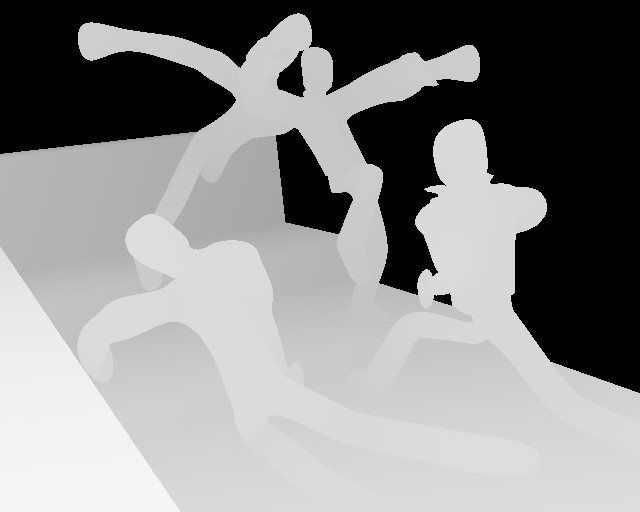
Just use SHIFT-F3 and save an image.

	Basically all this does is copy the zbuffer to a new Image buffer
	and pass that to the save image function.

Sample output:
	http://www.cs.umn.edu/~mein/blender/kungfu_zbuf255.jpg

	Also thanks to Jesterking for helping me debug dumbness... ;)
	and the nice screenshot.

Kent
The code that generated mipmaps took a real long time to do it... on a
5k x 5k image it took here (no optim, debug compile) 32.5 sec.

Recoded the very old filtering routine, which already brought it down to
2.8 seconds. Then tested if we even need this filtering... in many cases
the images are painted or photographs, which is filtered OK already.
Without the filter, the mipmap timing went down to 0.39 second. :)

http://www.blender.org/bf/filters/index1.html

Here's an example of two 'mips' generated with or without gauss filter.
Note that aliasing in an image remains there... which can be a wanted
effect anyway.

So; added the gauss filter as option in making mipmaps. Also had to
reshuffle the buttons there in a more logical manner.
There's also disabled code in the do_versions to set 'gauss' on in older
files. Will be enabled during release time.
+ 'scons blenderplayer' builds blender AND blenderplayer now (tested on Linux
  only, but was only linking issue, so should work on other platforms too).

  NOTE: I noticed some compileflags for GE specific libs that were left out -
  I re-enabled them in the SConscripts, but I'm going to do a test build my-
  self now, so if there are problems with them on win32, I probably already
  know about them :)