 a7283fc1d5
The distance sampling is mostly based on weighted delta tracking from
[Monte Carlo Methods for Volumetric Light Transport Simulation]
(http://iliyan.com/publications/VolumeSTAR/VolumeSTAR_EG2018.pdf).

The recursive Monte Carlo estimation of the Radiative Transfer Equation is
\[\langle L \rangle=\frac{\bar T(x\rightarrow y)}{\bar p(x\rightarrow
y)}(L_e+\sigma_s L_s + \sigma_n L).\]
where \(\bar T(x\rightarrow y) = e^{-\bar\sigma\Vert x-y\Vert}\) is the
majorant transmittance between points \(x\) and \(y\), \(p(x\rightarrow
y) = \bar\sigma e^{-\bar\sigma\Vert x-y\Vert}\) is the probability of
sampling point \(y\) from point \(x\) following exponential
distribution.

At each recursive step, we randomly pick one of the two events
proportional to their weights:
* If \(\xi < \frac{\sigma_s}{\sigma_s+\vert\sigma_n\vert}\), we sample
scatter event and evaluate \(L_s\).
* Otherwise, no real collision happens and we continue the recursive
process.

The emission \(L_e\) is evaluated at each step.

This also removes some unused volume settings from the UI:

* "Max Steps" is removed, because the step size is automatically specified
by the volume octree. There is a hard-coded threshold `VOLUME_MAX_STEPS`
to prevent numerical issues.
* "Homogeneous" is automatically detected during density evaluation

An option "Unbiased" is added to the UI. When enabled, densities above
the majorant are clamped.
Blender
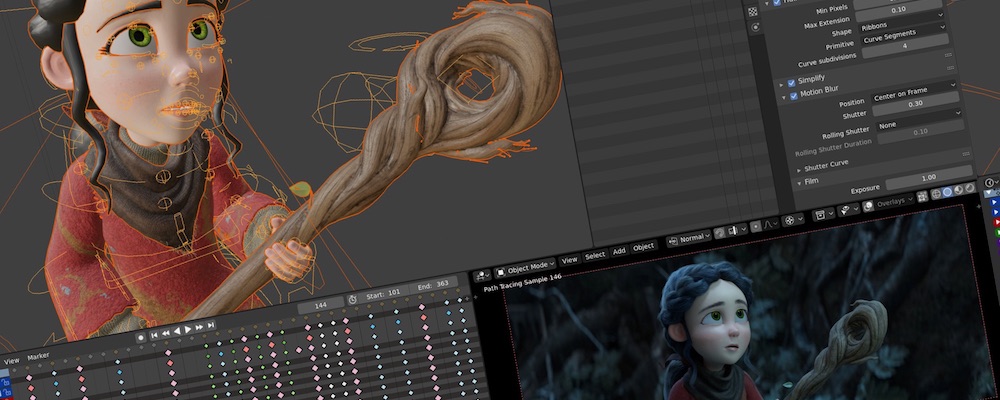
Blender is the free and open source 3D creation suite. It supports the entirety of the 3D pipeline—modeling, rigging, animation, simulation, rendering, compositing, motion tracking and video editing.
Project Pages
Development
License
Blender as a whole is licensed under the GNU General Public License, Version 3. Individual files may have a different but compatible license.
See blender.org/about/license for details.