 bfb0d2ad20
Mesh invariants imply that edges and faces must be unique, so things like reversed edges or duplicate faces with equal vertices are invalid. For this reason, every time we generate new elements we have to ensure that all new elements are unique between each other and already existing elements. The recent refactor (ea875f6f32) introduced a new algorithm to generate new mesh elements, and deduplication of new elements was also a part of it. The problem is that the deduplication only guaranteed that the original elements and new elements don't overlap; deduplication between each new elements is not complete. To solve the problem both new triangles and new edges have to be deduplicated, even if there is no duplicates. Just to know this we have to build a hash sets. Triangle deduplication is a special part of the triangulation code, but edges already handled elsewhere in the code base. This refactor fixes this by replacing the original approach with one which guarantees distinct faces and edges in the result. Unfortunately, this fix increases runtime of the node 10x for a simple cube with 500-vertex sides. It should be possible to make the performance better again, but that requires more work. Other work had to be done to enable this, so this depends on: - [x]157e7e0351- [x]fa8574b80bCo-authored-by: Hans Goudey <hans@blender.org> Pull Request: https://projects.blender.org/blender/blender/pulls/147634
Blender
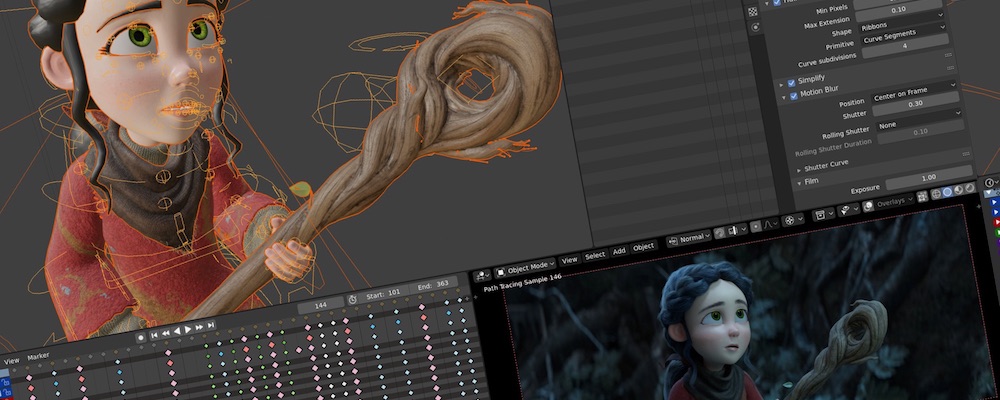
Blender is the free and open source 3D creation suite. It supports the entirety of the 3D pipeline—modeling, rigging, animation, simulation, rendering, compositing, motion tracking and video editing.
Project Pages
Development
License
Blender as a whole is licensed under the GNU General Public License, Version 3. Individual files may have a different but compatible license.
See blender.org/about/license for details.